The Accra-Helsinki Group for Sustainable Cooling
An informal community of like-minded individuals and groups focused on strengthening the Montreal Protocol on Substances that Deplete the Ozone Layer, and preventing ozone depletion and climate tipping points.
To advance a world of safe, efficient, and climate-friendly cooling and help prevent climate tipping points through strengthening the Montreal Protocol, ending environmental dumping, and accelerating the transition to sustainable cooling for all.
Background and Overview
The Accra-Helsinki Group was inaugurated in 2024. Like its predecessors, the Stockholm and Toronto Groups, the Group is an informal community of like-minded individuals and groups focused on strengthening the Montreal Protocol on Substances that Deplete the Ozone Layer and preventing ozone depletion and climate tipping points. Discussions center around current and future issues that may be addressed by the Montreal Protocol.
Unlike its predecessors, the Accra-Helsinki Group is unique in fostering strong collaboration between Article 5 (developing) and Article 2 (developed) Parties to pursue the Group’s goals.
The Group was initiated in response to concerns that inefficient cooling equipment using obsolete ozone-depleting substances (ODS) and hydrofluorocarbon (HFC) refrigerants is dumped into developing-country markets at prices so low that equipment necessary to avoid climate tipping points cannot compete for sales. In fact, in almost all of Africa and in many parts of Southeast Asia, energy-efficient cooling equipment with ozone- and climate-friendly refrigerants is not offered for sale.
Fortunately, Parties to the Montreal Protocol have agreed that the solution to this issue must involve exporters and importers (i.e., a “shared responsibility”). For instance, the EU and the US took the first steps by creating regulations to control the export of equipment that does not qualify for domestic sale. The challenge of the Accra-Helsinki Group is to put forward practical solutions for making this market transition.
Since that time, the Accra-Helsinki Group has expanded its focus to discuss other “unfinished business” of the Montreal Protocol by convening regular Side Events at Montreal Protocol meetings. This unfinished business is a critical part of the next decade of action for the Montreal Protocol—one of the world’s most successful treaties.
Chatham House Rule
The Chatham House Rule governs the Group’s meetings to encourage discussion outside the negotiating context.
The Group’s meetings are open to the Montreal Protocol community and are planned as Side Events at Open-ended Working Group (OEWG) meetings and Meetings of the Parties (MOPs).
Group Leadership
Media Coverage & Official Records
- Ghana News Agency: Africa Must Not Become a Dumping Ground for Inefficient Appliances — Kofi Agyarko
- Ghana News Agency: African Experts Push for Common Cooling Appliance Standards
- UNEP Document: History of Accra-Helsinki Group (Marco & Stephen)
- UNEP Ozone Secretariat: MOP-37 Side Events Schedule (Nov 3, 2025)
- UNEP Ozone Secretariat: OEWG-47 Side Events Schedule
- GBC Ghana Online: EU Greenhouse Gas Regulations • Mabel Adorkor Annang
- IGSD: History & Progress Stop Dumping Timeline
- IIR News: Live from OEWG Meetings — What is Accra-Helsinki Group?
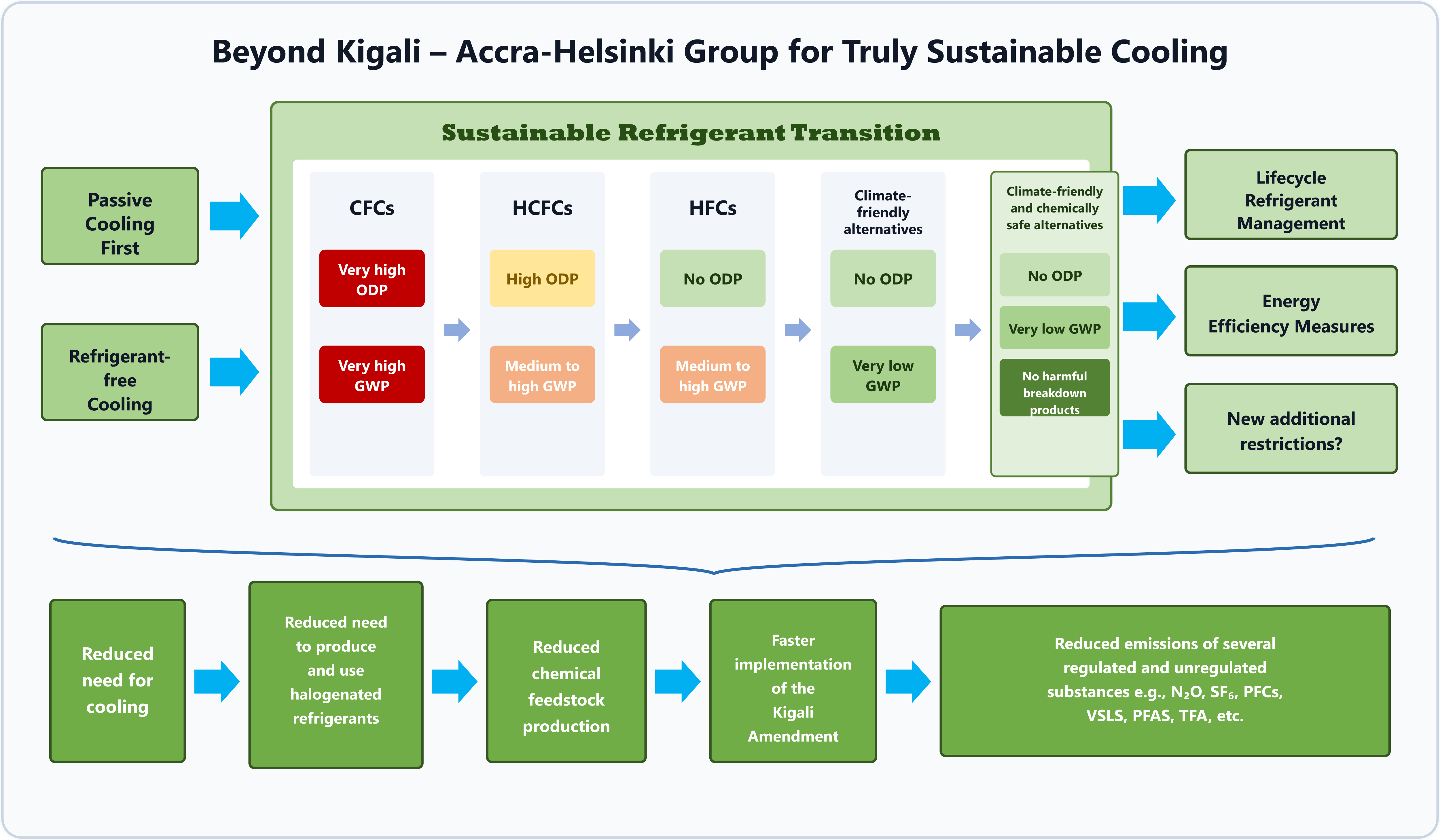
Beyond Kigali: Accra-Helsinki Group for Sustainable Cooling
The comprehensive architectural roadmap: connecting demand reduction, non-chemical cooling, refrigerant transitions, and lifecycle management to prevent climate tipping points.
Passive Cooling & Alternative Technologies
Implementing passive cooling solutions immediately worldwide as a first resort, and gradually fostering refrigerant-free Alternative Cooling Technologies (ACTs) taking into account improving Technological Readiness Levels (TRLs) and lifecycle impacts.
Safe Natural Alternatives (NatRef)
Shifting from fluorinated refrigerants to natural working fluids (propane, CO₂, ammonia) to prevent environmental and chemical lock-in of persistent PFAS (“forever chemicals”) and harmful TFA breakdown products.
Lifecycle, Feedstocks & Super-Pollutants
Lifecycle Refrigerant Management (LRM) coupled with Energy Efficiency MEPS to reduce the need for and emissions from feedstock production, speed Kigali implementation, and reduce emissions of N₂O, SF₆, VSLSs, and PFAS.
The MP10 Portfolio of Opportunities
Ten concrete, actionable priorities for the Montreal Protocol community to synchronize energy efficiency, phase down super-pollutants, prevent environmental dumping, and accelerate truly sustainable cooling worldwide.
1. Accelerating implementation of the Kigali Amendment (KA)
Strengthening phase-down schedules, expanding ratification, and supporting timely compliance.
2. Saving energy through parallel Energy Efficiency transformation of manufacturing with the refrigerant transition (EE)
Synchronizing energy efficiency improvements with refrigerant changeovers through Minimum Energy Performance Standards (MEPS) that apply equally to exporters and importers, in order to prevent the dumping of energy-inefficient appliances containing or relying on obsolete refrigerants.
3. Reducing leaks of halogenated substances through better Lifecycle Refrigerant Management (LRM)
Systematic recovery, reuse, reclamation, and safe destruction of refrigerants throughout the lifetime of equipment and at end-of-life.
4. Addressing feedstock emissions (FEEDST)
Monitoring, reporting, and reducing fugitive emissions and leaks from chemical feedstocks used in manufacturing processes.
5. Controlling and reducing emissions of Very Short-Lived Substances (VSLSs)
Addressing unregulated, anthropogenic short-lived chlorine and bromine compounds that impact stratospheric ozone.
6. Mitigating industrial nitrous oxide emissions (N₂O)
Deploying proven catalytic reduction and abatement technologies for point-source emissions from adipic and nitric acid industrial production.
7. Including Sulphur Hexafluoride (SF₆) in atmospheric control mechanisms
Bringing this ultra-potent greenhouse gas (GWP 22,800), widely used in electrical switchgear, under formal atmospheric control and phased transition pathways.
8. Shifting from fluorinated refrigerants to Natural Refrigerants (NatRef)
Prioritizing natural working fluids (e.g., propane, CO₂, ammonia) to avoid the environmental and chemical lock-in of persistent per- and polyfluoroalkyl substances (PFASs, the "forever chemicals").
9. Gradually shifting to refrigerant-free Alternative Cooling Technologies (ACTs)
Fostering non-vapor-compression technologies, taking into account their improving Technological Readiness Levels (TRLs) and lifecycle impacts.
10. Implementing Passive Cooling solutions immediately worldwide as a first resort (PASS)
Prioritizing shading, building orientation, natural ventilation, and reflective surfaces to prevent dangerous overheating and reduce energy demand before mechanical systems are activated.
Official Document: Accra-Helsinki Group for Sustainable Cooling: The MP10 Portfolio of Opportunities.
Meeting Information & Side Events
The Group convenes regular Side Events at Open-ended Working Group (OEWG) and Meetings of the Parties (MOPs).
Kigali Side Event: Accra-Helsinki Group for Sustainable Cooling
Help shape the agenda for upcoming Side Events at OEWG and MOP sessions:
Topics discussed: Regulatory measures on sulfur hexafluoride (SF₆), phasing down super-pollutants under the Montreal Protocol, practical market solutions. Drew over 40 participants co-chaired by Kofi Agyarko & Tapio Reinikainen.
Topics discussed: Formal inauguration of the Accra-Helsinki Group; establishing shared responsibility between Article 5 and Article 2 Parties; stopping the dumping of inefficient cooling appliances with obsolete ODS & HFCs.
History of Accra-Helsinki Group by Marco & Stephen (UNEP PDF)Topics discussed: What is the Accra-Helsinki Group, addressing market barriers, energy efficiency with refrigerant transition, and non-F-gas alternatives.
IIR/IIF Report: Live from OEWG Meetings